Skip to content
Call (951) 297-9994Licensed, insured and bonded · License #585047

Wood Siding Repair and Painting in Temecula

Temecula Premier Painting is a specialist in Riverside County for wood siding painting in Temecula, CA, specializing in lap siding painting, board and batten refinishing and hardboard siding repair. We offer rot probing and failed board replacement.

  • Free on-site estimate
  • Written scope, coat by coat
  • Colors you approve first

Get a free painting estimate

Or call (951) 297-9994. Calls only, we do not receive text messages.

About our wood siding painting & repair

Our team provides back-primed replacement boards, delivering siding that sheds water at every lap and joint, for both residential and commercial projects. Our own crew probes every course with you watching, and we write each board to be replaced, the stain-blocking primer and the number of finish coats into the scope before painting starts.

From cutting out a soft section under a window sill to the final coat on the top course, our team handles every detail. Serving Temecula, Fallbrook, Bonsall and Valley Center, we judge older ranch siding one board at a time instead of by the look of the whole wall.

Why Temecula Premier Painting

How We Work

The person who looks at your walls is the person you call back, from the estimate to the final walk.

Scope in writingEach surface gets its prep, primer and coat count spelled out
Samples up firstColors tested on your own wall, and HOA submittals ready for the board
Named crewThe crew written on the estimate is the crew on your driveway
Licensed & bondedInsured, with the California licence number in the header and footer

Probing for rot and swelling

Peeling wood siding can usually be repaired and repainted, but only after every soft or swollen board is found and replaced, because paint laid over decayed wood lets go again almost as soon as it dries. Wood rots when it stays wet: decay fungi need moisture above the fibre saturation point to take hold, so the damage collects wherever water sits.

  • The bottom course, closest to soil, mulch and sprinkler spray.
  • Under window sills and at the ends of boards that butt into trim.
  • Below gutters that overflow and behind downspouts.
  • At lap joints where old caulk has split and let rain run behind the board.

We press an awl into suspect spots on every course, not just the ones that look bad. Sound wood resists the point; decayed wood lets it sink in or crumble. Every soft section is marked, photographed and written into the scope with its board count, so you see exactly what is being replaced before we cut anything.

If the house was built before 1978, the old paint is tested before any scraping or sanding. Federal rules for homes of that age call for lead-safe work practices whenever painted surfaces are disturbed, so we contain the work area, keep dust down and clean up with HEPA equipment when the test calls for it.

Hardboard, lap and board and batten

Each siding type fails in its own way, so each gets its own repair.

Lap siding

Lap siding, also called clapboard or bevel siding, is beveled boards laid horizontally from the bottom up, each board lapping the one below so water sheds outward. Flat-sawn boards cup more and hold paint less well than vertical-grain boards, so on a flat-sawn wall we expect more cupped or split boards and budget for them.

Board and batten

Vertical boards with a narrow batten nailed over each joint. Vertical siding drains better than horizontal and takes the sun at a lower angle, but battens that have pulled loose leave an open joint behind them. Loose battens are refastened with corrosion-resistant nails, since plain steel nails leave rust spots in the paint.

Hardboard

Hardboard is high-density fibreboard made from compressed wood fibres, and tempered hardboard is the grade used for siding. It takes paint well while its coating is intact, but once the coating fails at a bottom edge the board can swell and soften, and a swollen edge will not lie flat again. Those boards are replaced, not painted over. Water-soluble extractives in hardboard can also leach through paint and discolour it, which is why it gets an acrylic latex stain-blocking primer under the topcoats.

T1-11 and grooved panels

Grooved plywood panels check on the surface when they weather. They are sealed and primed with extra attention to the grooves and the bottom edge, where water collects.

Back-priming and sealing new boards

Every replacement board is primed on all six faces and its cut ends sealed before it goes on the wall, so moisture cannot get into it from behind. A coat on the face alone leaves the back, the edges and the end grain bare, and end grain absorbs water far faster than the face of the board. Finishes generally fail first at the ends, and a board treated over its whole surface also slows water wicking up the back of lap siding.

  • New boards are cut to length, then the cut ends get a liberal coat of sealer or primer before installation.
  • Backs and edges are primed on the ground, where they can be reached, rather than skipped once the board is nailed up.
  • Cedar and redwood replacements get a stain-blocking primer, because their water-soluble extractives can rise through a light colour as reddish-brown streaks.
  • Boards are fastened with hot-dipped galvanised or stainless nails.

We match the profile of your existing siding as closely as the lumber yards allow. When an exact profile is no longer made, we tell you before ordering and agree on the closest match or on moving a section of original boards to the most visible wall.

Caulking laps and trim joints

Gaps where siding meets trim, windows and corner boards are sealed with a flexible caulk so the boards can move with heat and moisture without cracking the paint film. Siding is made of pieces smaller than the wall precisely so it can expand and contract, and a rigid filler at those joints simply splits on the first hot week.

  • Acrylic latex caulk is used at trim joints because it stays flexible and takes paint cleanly.
  • Deep gaps get a foam backer rod first, so the caulk bonds to the two sides of the joint and not the bottom, which lets it stretch instead of tearing.
  • The bottom edge of each lap board is left open. That overlap is how lap siding sheds water, and sealing it traps whatever gets behind the board.
  • Nail holes and small splits are filled and spot-primed before the finish coats.
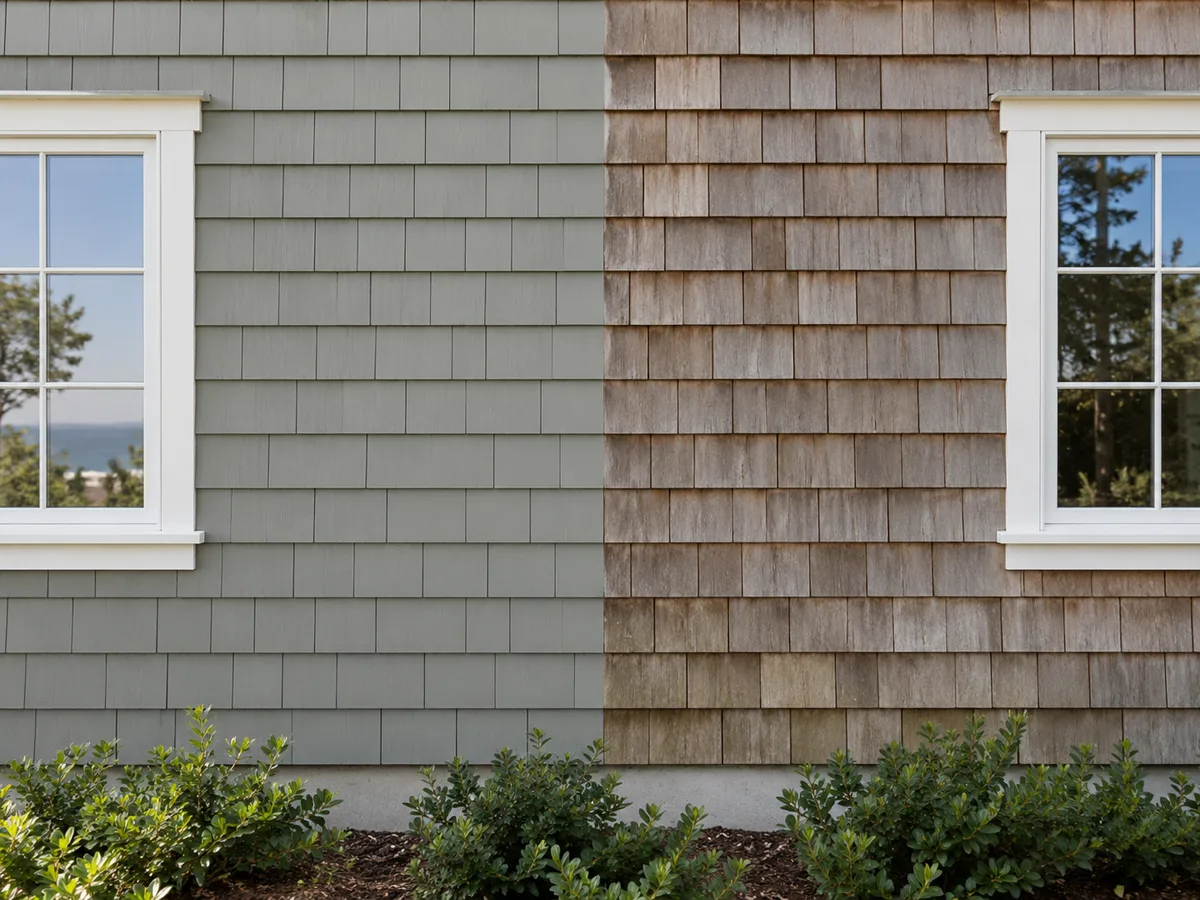
Cedar shingle wall split down the middle, the left half painted sage grey and the right half still weathered bare cedar, white-trimmed windows on each side.

Wood siding repair and repaint pricing

Wood siding restoration and repaint for a whole wood-clad house is typically estimated at roughly $6,000 to $20,000, based on regional painting price data, and the board count decides most of the spread. A house with sound siding that only needs prep and paint sits near the bottom; one with many replaced boards, hardboard failure and two stories sits near the top.

  • How many boards are replaced, and whether matching profiles are still made.
  • The siding type: hardboard and flat-sawn lap usually need more repair than vertical-grain cedar.
  • Paint testing, containment and HEPA cleanup when the siding predates 1978.
  • Height, stories and access around landscaping and slopes.
  • Caulking and trim repair at windows and corners.
  • Paint or solid stain, the number of colours, and a colour change versus the same colour.
  • Sun-faded south and west walls that need extra prep and coverage.

The figures above are estimates and may change after we probe the siding; the final price is written in your quote once every soft board has been counted.

Wood accents on stucco houses and rentals

Not every wood repair is a whole wood-clad house. On a stucco home, wood often appears as a gable panel, a bay window surround or an accent wall, and it gets the same probing, back-primed replacement and caulking on a smaller scope. Landlords and property managers with wood-sided rentals can have each building scoped and priced separately, so repairs are approved board count by board count before anyone climbs a ladder.

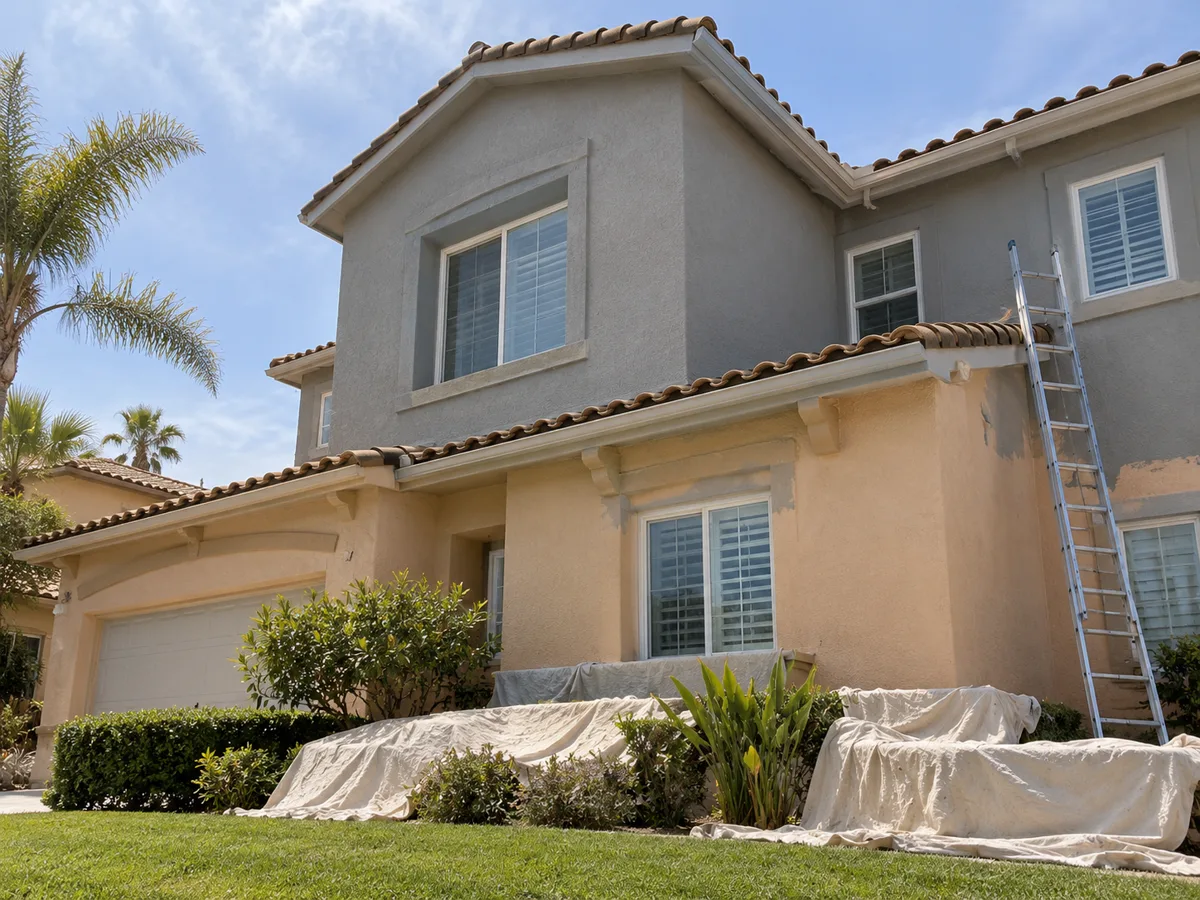
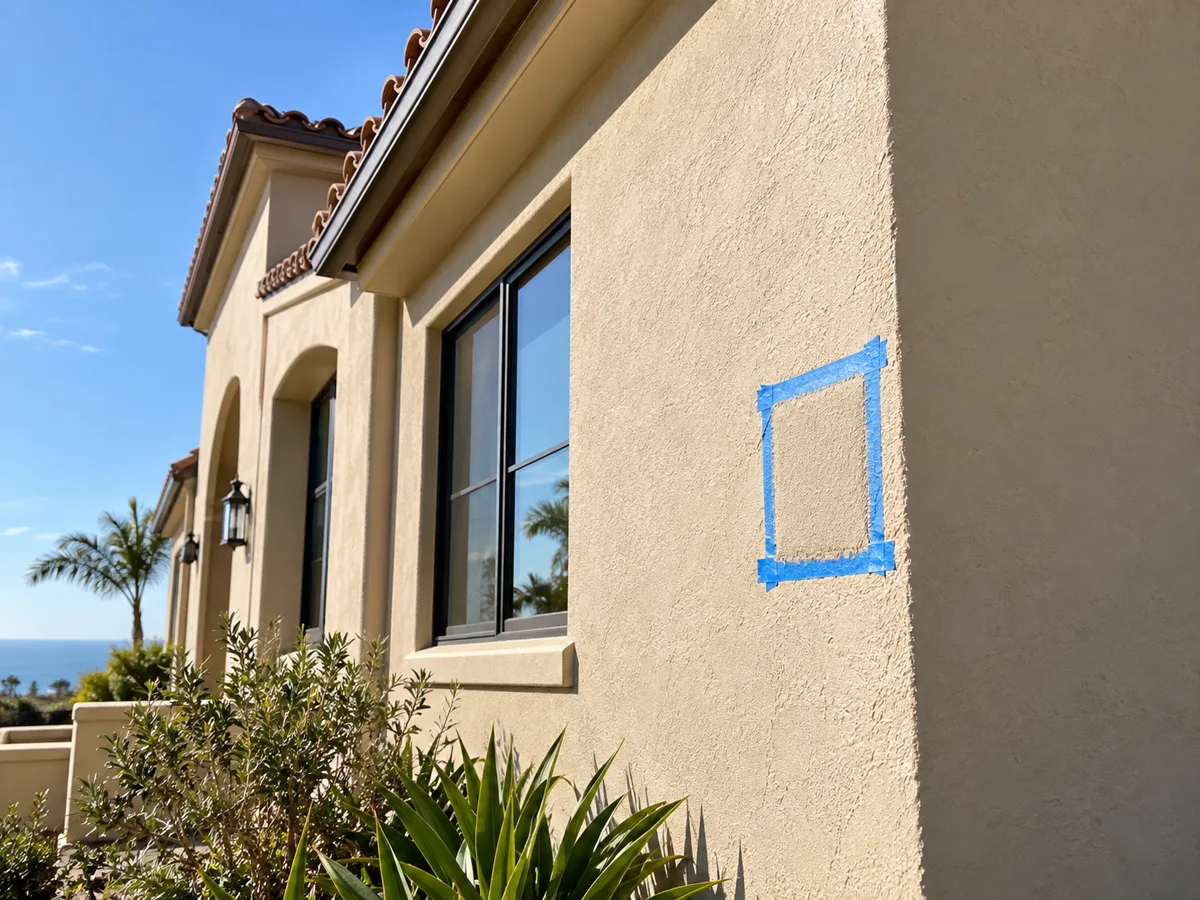
Two-story stucco house mid-repaint, the upper storey fresh warm grey and the lower storey still faded peach, an aluminium extension ladder against the wall and drop cloths over the shrubs.

Colors and Finishes

The process

How a Painting Job Runs

Four steps, and no paint goes on until you have signed off on the scope and the colors.

  1. The walk

    We go around the house or property with you, check the stucco, the trim and the existing coating, and note what inland sun, dust and dry Santa Ana winds have done to each elevation.

  2. The written scope

    The prep, products, colors and dates arrive in writing. For a community or a commercial building the scope is split into phases, so every resident or tenant knows their day.

  3. Prep, then paint

    Washing, scraping, patching and caulking come before any color, since that is what the new coating grips. Primer follows where the surface needs it, then the finish coats.

  4. The final walk

    We walk the job again together before calling it finished, and touch up anything you flag.

Questions

Wood Siding Painting & Repair: Common Questions

Can my rotting wood siding be repaired, or does it need replacing?

Most siding can be repaired by replacing only the boards that are soft or swollen. Whole-wall replacement makes sense only when decay is spread across most of the boards, and we show you the probe results so the call is yours.

How much does wood siding repair and painting cost in Temecula?

A whole wood-clad house is typically estimated at roughly $6,000 to $20,000, with the number of replaced boards moving it most. Your written quote, made after we probe the siding, sets the final price.

Should I paint or stain my wood siding?

Paint lasts best on smooth, vertical-grain boards, while penetrating stains suit rough-sawn and flat-sawn wood. Hardboard should be painted, since semi-transparent stain does not suit it. We recommend one or the other after seeing your boards.

Can you match my existing siding profile?

Usually, yes. If your exact profile is discontinued, we tell you before ordering and agree on the closest match, or move original boards from a hidden wall to the street side.

Why is my hardboard siding swelling at the bottom?

Its coating has failed at the bottom edge and the board has taken on water. Once a hardboard edge swells it will not flatten again, so those boards are replaced and the new ones primed on every face before painting.

What if you find termite damage?

Ants and termites are a known threat to wood siding. If we see signs of them, we stop work on that section and recommend a pest inspection before boards are replaced, so new wood does not go up over an active problem.

Is wood siding work covered by a warranty?

Yes. Repairs and paint are covered by a written warranty, with the terms laid out in your written quote before you sign.

Free on-site estimate

Talk to us about wood siding painting & repair

Homeowners get a free estimate at the property. Boards, managers and builders can send plans or a unit count for a bid.

Call (951) 297-9994

Licensed, insured and bonded · License #585047. Calls only, we do not receive text messages.

Call (951) 297-9994Licensed, insured and bonded · License #585047