Skip to content
Call (951) 297-9994Licensed, insured and bonded · License #585047

Stucco Painting and Elastomeric Coating in Temecula

Temecula Premier Painting is a leading Riverside County contractor for stucco painting in Temecula, CA, specializing in elastomeric wall coating, breathable acrylic repaints and hairline crack repair. We offer masonry primer over chalky stucco and texture-matched patching.

  • Free on-site estimate
  • Written scope, coat by coat
  • Colors you approve first

Get a free painting estimate

Or call (951) 297-9994. Calls only, we do not receive text messages.

About our stucco painting & elastomeric coating

Our team provides efflorescence diagnosis before any painting starts, delivering stucco walls that read as one even surface rather than a map of old repairs, for both residential and commercial projects. We test adhesion and moisture on your own walls first, then write the coating, the primer and the coat count into the painting scope you sign, so the choice between elastomeric and acrylic rests on what your stucco shows.

From raking out and refilling a hairline crack to the last coat across a full elevation, our team handles every detail. Serving Temecula, French Valley, Rainbow and Fallbrook, we schedule coating days around the wind and the first storms of the wet season.

Why Temecula Premier Painting

How We Work

The person who looks at your walls is the person you call back, from the estimate to the final walk.

Scope in writingEach surface gets its prep, primer and coat count spelled out
Samples up firstColors tested on your own wall, and HOA submittals ready for the board
Named crewThe crew written on the estimate is the crew on your driveway
Licensed & bondedInsured, with the California licence number in the header and footer

Elastomeric or acrylic: which one your stucco needs

Elastomeric coating suits Temecula stucco that is sound and dry but covered in hairline cracks, while a breathable 100 percent acrylic suits stucco that is sound and mostly uncracked. The difference is the film. An elastomer is a polymer that stretches and recovers, so a thick elastomeric coat can span a hairline crack that would show straight through ordinary paint; one manufacturer's data sheet lists crack bridging with over 300 percent elongation. That thickness is also the risk: stucco is porous, and a heavy film over a wall that is already wet can hold the moisture in.

When elastomeric fits

A wall with many fine cracks, sound stucco underneath, no active leak and no fresh bloom. Elastomeric goes on as a two-coat system, because the data sheets call for two coats to reach the full elastomeric properties, and it costs more in material and labour than a standard repaint.

When a breathable acrylic fits

Sound stucco with few cracks, walls that need to dry out between storms, and homes where the owner wants the stucco texture to stay crisp. A standard acrylic film is thinner, so it softens texture less.

When neither should go on yet

Stucco that is wet, actively blooming white salts, delaminating from the lath, or cracked wide enough to suggest movement. Elastomeric product sheets require the surface to be clean, dry, sound and free of efflorescence, and we hold to that. The wall gets diagnosed and repaired first, and the coating waits. Portland cement stucco is hard and brittle and can crack if the base under it moves, which is why we never sell elastomeric as a cure for structural cracking. It hides and bridges hairlines. It does not stop a wall that is shifting.

Hairline cracks and matching patch texture

A patched crack has to match the texture around it, or it shows as a smooth stripe once the wall is painted. Stucco finish coats are troweled smooth, hand-textured, floated to a sand finish or sprayed, and most Temecula tract homes carry one of those finishes across every wall, so the patch has to be built to the same pattern.

  • Hairline cracks are cleaned out and filled with a compatible patching material, because coating manufacturers require cracks and voids filled before the coating goes on.
  • Wider cracks are opened up, filled and then textured with a sponge float, hawk and trowel or a hopper gun, depending on whether the wall is sand finish, lace or a heavier hand texture.
  • Each patch is primed so it absorbs paint the same way as the wall around it, which keeps it from flashing as a dull or shiny square.
  • Control joints, expansion joints and the weep screed at the base of the wall stay open. Those accessories let the stucco move and let water drain, and coating them shut defeats them.

We show you a finished patch on a hidden wall first. If you can find it from the patio, we redo the texture before moving on.

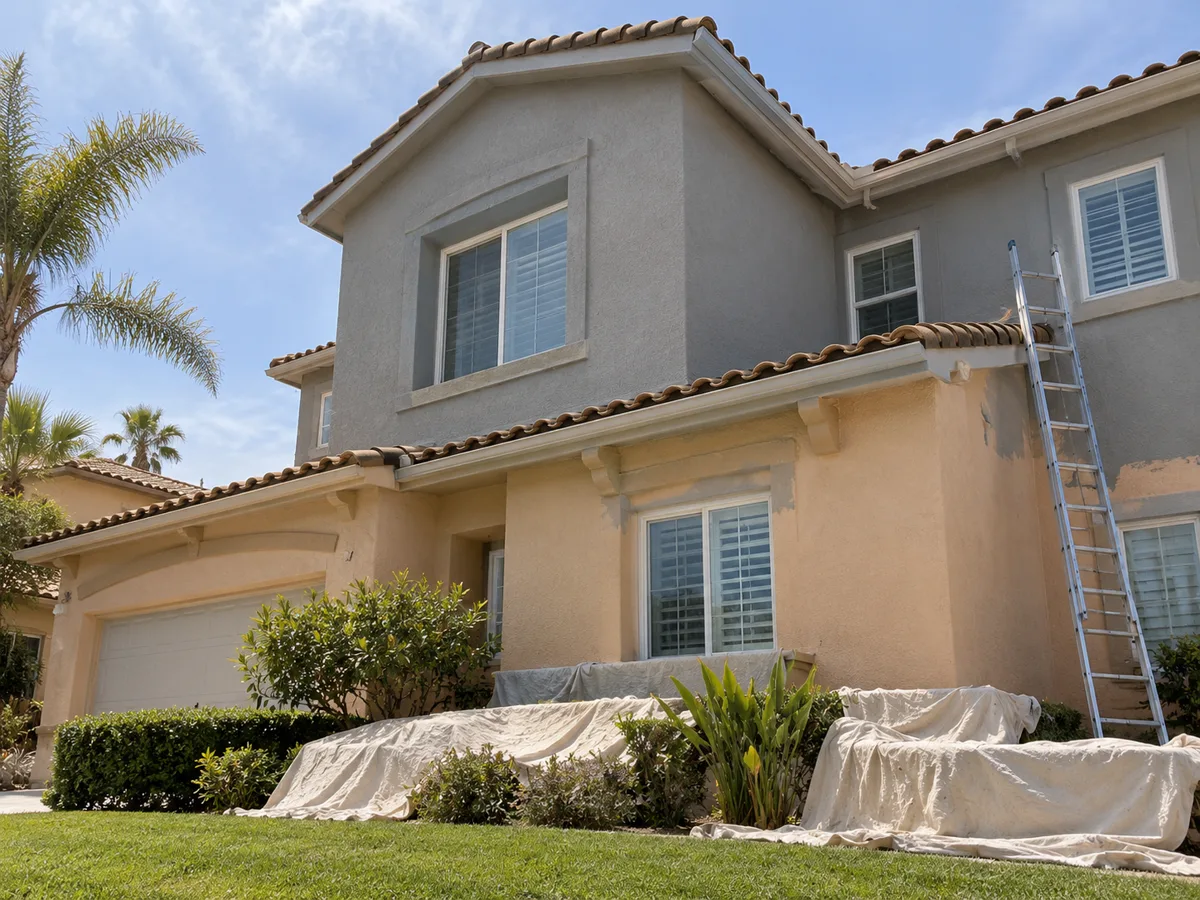
Two-story stucco house mid-repaint, the upper storey fresh warm grey and the lower storey still faded peach, an aluminium extension ladder against the wall and drop cloths over the shrubs.

Chalking and sealing with a masonry primer

Chalky stucco is washed and then sealed with a masonry primer, because a premium topcoat laid over loose chalk sticks to the chalk instead of the wall. Chalking is the binder in the old paint breaking down under sunlight and moisture, leaving a powder that comes off on your hand. In a hot semi-arid valley where August is usually the hottest month, the south and west walls chalk first and heaviest.

The wash removes what it can. The primer binds what is left and evens out how the wall absorbs the next coat, which matters on patched stucco where some areas are new and some are years old. Coating manufacturers make stucco primers for exactly this job, and the one we specify is named on your scope along with its product data sheet.

We also do a simple tape test after the wash. If old paint lifts with the tape, it is scraped back to a firm edge before anything else, since no primer can glue failed paint back to the wall.

Efflorescence and moisture in the wall

White, powdery bloom on stucco means water is moving through the wall and carrying salts out to the surface, so the source is found before any coating goes on. Efflorescence forms when water dissolves salts inside a porous material, migrates to the surface and evaporates, leaving the salt behind. The light, fluffy kind usually brushes off and is a cosmetic problem; bloom that keeps returning in the same place points to a steady water source.

  • Sprinkler heads spraying the wall, or a planter bed built up above the weep screed.
  • A downspout dumping against the foundation, or a gutter overflowing at one corner.
  • A cracked window sill, a gap at a light fixture, or a roof-to-wall flashing that lets winter rain in, since most Temecula rain falls between November and March.

We brush the bloom off, read the wall with a moisture meter, note the readings on the scope and fix or flag the source. Water repellents that trap moisture inside masonry have caused more trouble than they solved, which is the whole reason a damp wall waits.

Single-story tan stucco ranch home with dark brown trim and garage door, a rock and boulder garden with agave, oak trees and granite boulder hills behind at sunset.

Stucco coating price per square foot

Stucco painting and elastomeric coating are typically estimated at roughly $2.50 to $6 per square foot of wall, or roughly $6,000 to $20,000 for a whole house, based on regional painting price data. Elastomeric sits toward the upper end because it goes on thicker and in two coats.

  • Wall area, stories and how many elevations need a lift or tall ladders.
  • Crack count and how much texture matching the patches need.
  • How heavily the walls chalk, and whether failed paint has to be scraped first.
  • Elastomeric versus a standard acrylic system, and the product line chosen.
  • Moisture sources that have to be fixed before coating, such as sprinkler overspray or a buried weep screed.
  • A colour change, and sun-faded west and south walls that need extra coverage.
  • Landscaping, tile and hardscape that have to be protected along every wall.

These figures are estimates and can change once we see the wall; the final price is the one in your written quote, and it is set by the crack count, the coating system and the wall area we measure on site.

Stucco on association and commercial buildings

Associations, apartment owners and commercial owners face the same elastomeric or acrylic choice across many buildings at once. For a board or a property manager we test sample walls on several buildings, submit the product data for the system we propose, coat a mockup area for approval and then bid by building and elevation, so every bidder prices the same scope. Community-wide work is bid on our HOA repainting service and our commercial painting service.

Dining and living room with soft blue-grey walls, white trim and crown moulding, a wood dining table under a woven pendant, and a roller on an extension pole beside a paint can in the corner.

Colors and Finishes

The process

How a Painting Job Runs

Four steps, and no paint goes on until you have signed off on the scope and the colors.

  1. The walk

    We go around the house or property with you, check the stucco, the trim and the existing coating, and note what inland sun, dust and dry Santa Ana winds have done to each elevation.

  2. The written scope

    The prep, products, colors and dates arrive in writing. For a community or a commercial building the scope is split into phases, so every resident or tenant knows their day.

  3. Prep, then paint

    Washing, scraping, patching and caulking come before any color, since that is what the new coating grips. Primer follows where the surface needs it, then the finish coats.

  4. The final walk

    We walk the job again together before calling it finished, and touch up anything you flag.

Questions

Stucco Painting & Elastomeric Coating: Common Questions

Is elastomeric coating better than regular paint for stucco in Temecula?

Only on stucco with many hairline cracks that is sound and dry. On a wall with few cracks, a breathable acrylic usually serves better and keeps the texture sharper. We decide after testing your walls, not before.

Will elastomeric coating stop my stucco cracks from coming back?

It bridges hairline cracks and stretches with small seasonal movement, so fine cracks stay hidden. It will not stop a crack caused by a wall or foundation that is moving, and we tell you if your cracks look like that kind.

Can elastomeric go over the paint already on my stucco?

It depends on the product and on the old paint. Some elastomeric data sheets list existing coatings as something to remove or prime over, so we check the sheet for the exact product we propose and test the old paint's grip with tape before writing the scope.

What is the white powder on my stucco walls?

That is efflorescence, salt carried out of the wall by water. It brushes off, but if it keeps coming back in the same spot, water is still getting in there, often from a sprinkler, a planter or a downspout, and that has to be fixed before coating.

Will my stucco patches show after painting?

Not if the texture is matched. Every patch is built to the finish around it, sand, lace or hand texture, and primed before colour. We show you a test patch first so you can judge it in daylight.

How much does stucco painting cost in Temecula?

Most homes are typically estimated at roughly $6,000 to $20,000, or roughly $2.50 to $6 per square foot of wall, with elastomeric toward the top. Your written quote sets the final price after we measure the walls.

How soon can new stucco repairs be painted?

Patches have to be dry and cured to the patching product's instructions before primer goes on. We list that wait on your written schedule so the coating days are planned around it rather than rushed.

Do you paint stucco on rental properties and association buildings?

Yes. For owners, managers and boards we submit product data, coat an approved mockup area and bid by building and elevation, and residents get notice before work reaches their unit.

Free on-site estimate

Talk to us about stucco painting & elastomeric coating

Homeowners get a free estimate at the property. Boards, managers and builders can send plans or a unit count for a bid.

Call (951) 297-9994

Licensed, insured and bonded · License #585047. Calls only, we do not receive text messages.

Call (951) 297-9994Licensed, insured and bonded · License #585047