Hard-water rings
Pale arcs at the height of the sprinkler spray. They are washed and treated before priming, and we ask you or your landscaper to turn or swap the heads that hit the wall.

Temecula Premier Painting is a trusted Riverside County specialist in block wall painting in Temecula, CA, specializing in slump stone painting, CMU perimeter wall coatings and block filler priming. We offer sprinkler stain cleanup and efflorescence treatment.
Our team provides shared wall coordination with the owner next door, delivering yard walls that look even from both sides of the property line, for both residential and commercial projects. We walk the full length of the wall with you, mark every stain and patch of bloom, and write the cleaning method, the filler or primer and the coat count into the estimate before any painting begins.
From brushing white salt off a mortar joint to the last coat on a cap block, our team handles every detail. Serving Temecula, Canyon Lake and French Valley, we arrange gate and yard access ahead of time so both faces of a shared wall can be reached.
Why Temecula Premier Painting
The person who looks at your walls is the person you call back, from the estimate to the final walk.
Block walls in Temecula can be painted well, but only after the first coat fills the block, because concrete block is porous and drinks paint unevenly. A concrete masonry unit is cast from Portland cement and aggregate, usually sand and fine gravel, often with hollow cores, and in the western states lighter blocks are sometimes made with porous lava rock gravel. Split-face and other textured units are made rough on purpose. Every one of those faces soaks up a topcoat in patches if it goes on bare.
So the first coat on bare or previously unpainted block is a block filler, a heavy-bodied primer made for porous cinder and concrete block. It fills and bridges pinholes and small voids, keeps water from soaking into the block and mortar joints, and gives the topcoat an even surface to sit on.
Slump stone takes longer than flat block. Its rough, uneven faces and deep recesses have to be reached from several angles, and the filler has to be pushed into each hollow rather than skimmed across the top. That extra labour is written into the estimate as its own line, not buried.
Sprinkler stains on a block wall come back within weeks unless the water source is fixed along with the paint, so cleaning and head adjustment are part of the scope. Hard water carries dissolved calcium and magnesium minerals, and every time a sprinkler wets the wall and dries, it leaves a little more behind.
Pale arcs at the height of the sprinkler spray. They are washed and treated before priming, and we ask you or your landscaper to turn or swap the heads that hit the wall.
Traces of iron in hard water oxidise and stain mineral deposits a rust-orange colour. These spots are cleaned and sealed with a stain-blocking primer, or they bleed straight through a light new colour.
Efflorescence is salt carried out of the block by water moving through it. The light, fluffy kind brushes off. Bloom that keeps returning means water is still entering, often from soil or a planter piled against the base, and it is addressed before coating. A water-repellent sealer can reduce it, but it cannot permanently prevent it while the water keeps coming. If a wall stays wet from irrigation, no coating stays clean on it. We would rather tell you that on the walk than repaint the same stains next spring.
A block wall on the property line belongs to both lots, so the side facing your neighbour is painted only when the neighbour, or the association that owns the wall, agrees. California Civil Code section 841 says adjoining landowners share equally in maintaining the boundaries between them, and presumes that neighbours share an equal benefit from a fence dividing their properties and equal responsibility for its reasonable maintenance costs, unless they agree otherwise in writing. When one owner wants to recover costs, the statute expects advance written notice describing the problem, the proposed fix, the estimated cost, the proposed split and a timeline.
We are painters, not lawyers, so whether a particular block wall counts as a boundary fence under that statute, and who pays, is a question for you, your neighbour or your association. Our part is an estimate clear enough that everyone can agree on it, and a crew that stays on the side it has permission to be on.
The parts of a block wall that fail first are the cap, the pilasters and the bottom course, and each is prepared differently.
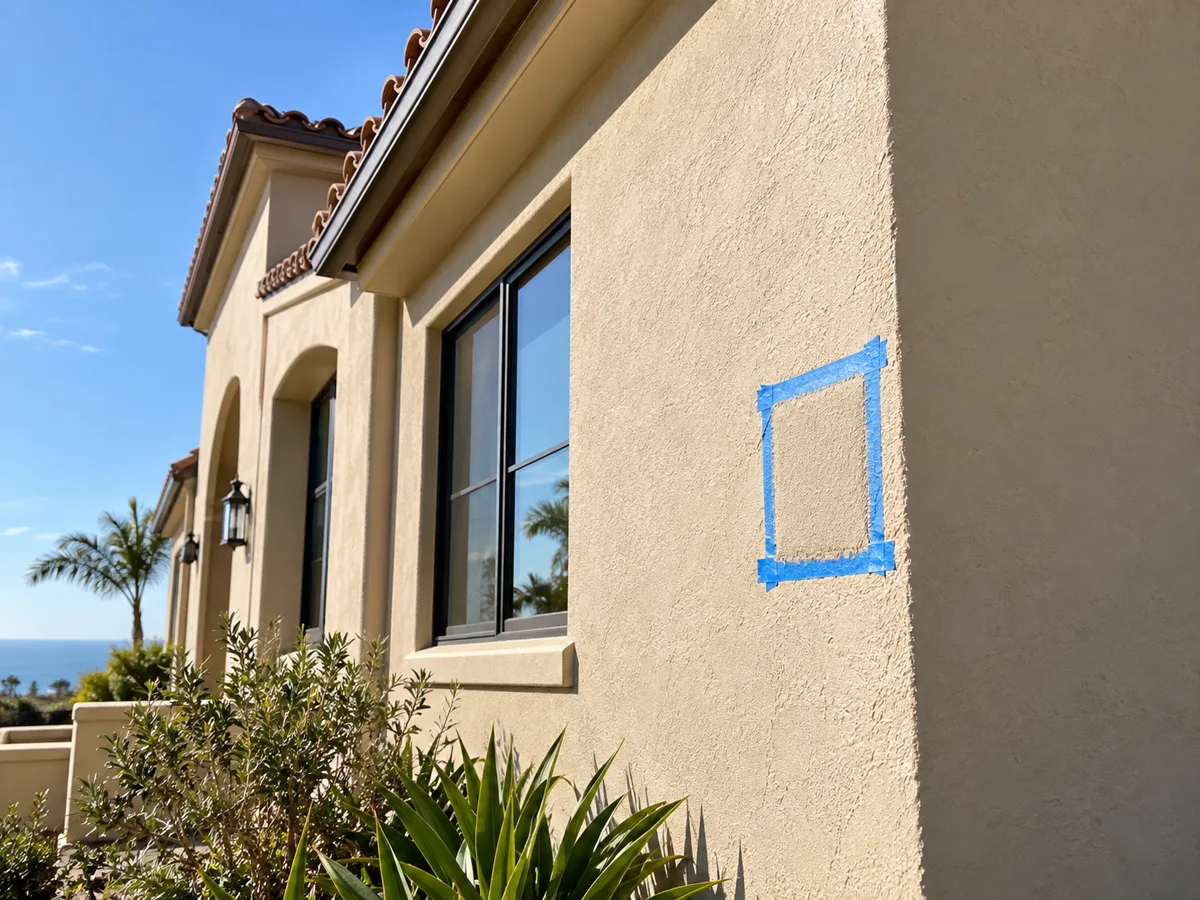
Most homeowners choose one colour for the whole run so the wall reads as a quiet backdrop for the yard, and associations often set that colour for perimeter walls. We paint a sample on a section you can see from the patio before the full run begins.
A typical Temecula yard or perimeter wall job is estimated at roughly $1,500 to $6,000, and the number that decides where a wall lands is its length times its height. We measure the run in linear feet, note the height of each section and count how many faces are being painted.
All prices here are estimates and subject to change; the final price comes from the written quote we hand you after measuring the wall, and it turns mostly on footage, texture and whether one face or two are painted.
The process
Four steps, and no paint goes on until you have signed off on the scope and the colors.
We go around the house or property with you, check the stucco, the trim and the existing coating, and note what inland sun, dust and dry Santa Ana winds have done to each elevation.
The prep, products, colors and dates arrive in writing. For a community or a commercial building the scope is split into phases, so every resident or tenant knows their day.
Washing, scraping, patching and caulking come before any color, since that is what the new coating grips. Primer follows where the surface needs it, then the finish coats.
We walk the job again together before calling it finished, and touch up anything you flag.
Service area
Questions
Yes. Slump stone takes paint well once its rough faces are filled with a block filler coat. It takes longer than flat block because every hollow has to be reached, and the estimate shows that time on its own line.
To paint your own side, generally no. To paint their side, yes, or the association's approval if it owns the wall. California treats a dividing fence as a shared responsibility, so we write an estimate you can share with your neighbour if you want to split the work.
Not by itself. White bloom is salt pushed out by water moving through the block, so the water source has to stop first. Once it does, the bloom is brushed off, the wall is primed and the new paint stays clean.
Because the sprinklers keep wetting the wall with hard water. The minerals dry on the paint the same way they dried on the block. Turning or swapping the heads that reach the wall is the only lasting fix, and we point out every one on the walk.
Most yard and perimeter walls are typically estimated at roughly $1,500 to $6,000, with length, height, texture and the number of faces moving it most. Your written quote, made after we measure, sets the final price.
Only if their face of the wall is being painted, or if a section can only be reached from their side. We arrange that with you before the start date and never enter a neighbour's yard without their permission.
Yes. Boards and community managers can have perimeter and common-area walls bid by street or by linear foot, with the colour approved by the board and owners notified before work reaches their section.
Homeowners get a free estimate at the property. Boards, managers and builders can send plans or a unit count for a bid.
Licensed, insured and bonded · License #585047. Calls only, we do not receive text messages.